
Discover South Carolina – The eighth state of the original thirteen states of the USA
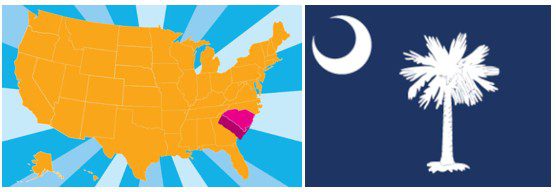
South Carolina was the eighth state to be ratified in the Constitution on May 23, 1788.
The first 13 states of the United States of America were comprised of the original British colonies established between 17th and 18th centuries.
Today, the American flag prominently displays 13 horizontal red and white stripes representing the original thirteen colonies.
Fast Facts
- Nickname: The Palmetto State
- Statehood: 1788; 8th state
- Capital: Columbia
- Biggest City: Columbia
- Abbreviation: SC
- State Bird: Carolina wren
- State Flower: Yellow jasmine
History
- People arrived in the area now called South Carolina over 50,000 years ago. Native American tribes such as the Cherokee, Creek, and Santee have lived here for thousands of years.
- In 1670, the English established a large settlement in the region. Then in 1710 they divided the territory into two colonies: North and South Carolina. Soon after, European settlers came to build plantations to grow rice and indigo, a natural dye used to color cotton.
- Soon South Carolina and the other American colonies wanted independence from England. This led to the American Revolution, which began in 1775. During the war, South Carolina hosted more battles than any other colony.
- South Carolina was the first state to leave the Union in the years leading up to the Civil War, which started in 1861. It rejoined the United States in 1868.
Why is it called South Carolina?
- The Carolinas were named after King Charles I of England.
- The state’s nickname, the Palmetto State, was coined in honor of the state tree, the sabal palmetto. During the Revolutionary War, these trees were used to build forts because their soft wood could absorb cannonball impacts.
Geography
- Shaped roughly like a triangle, South Carolina is bordered by North Carolina in the north, the Atlantic Ocean in the east, and Georgia in the south and west. The state can be divided into three regions.
- South Carolina’s forests cover more than 67 percent of the state, and they’re also one of the state’s biggest natural resources, particularly loblolly pine.